> ## Documentation Index
> Fetch the complete documentation index at: https://devzone.nayax.com/llms.txt
> Use this file to discover all available pages before exploring further.
# Remote Start
In the Remote Start Flow, your remote server initiates the transaction, directing Nayax to activate a specific device. This method is particularly suited for scenarios where the transaction begins from an application or a computer, rather than directly at the Nayax terminal.
The Remote Start flows use the following Spark methods:
* [StartAuthentication](/reference/spark/transactions/startauthentication)
* [TriggerTransaction](/reference/spark/transactions/triggertransaction)
* [TransactionCallback](/reference/spark/transactions/transactioncallback)
* [Settlement](/reference/spark/transactions/settlement)
* [CancelTransaction](/reference/spark/transactions/canceltransaction)
* [TimeoutCallback](/reference/spark/transactions/timeoutcallback)
* [DeclineCallback](/reference/spark/transactions/declinecallback)
**Payment Flows**
Remote Start supports both pre-authorization and pre-selection transaction flows. The sections below provide a more detailed breakdown of each flow.
## Pre-Authorization Flow
To understand the remote start pre-authorization flow, see the diagram below:
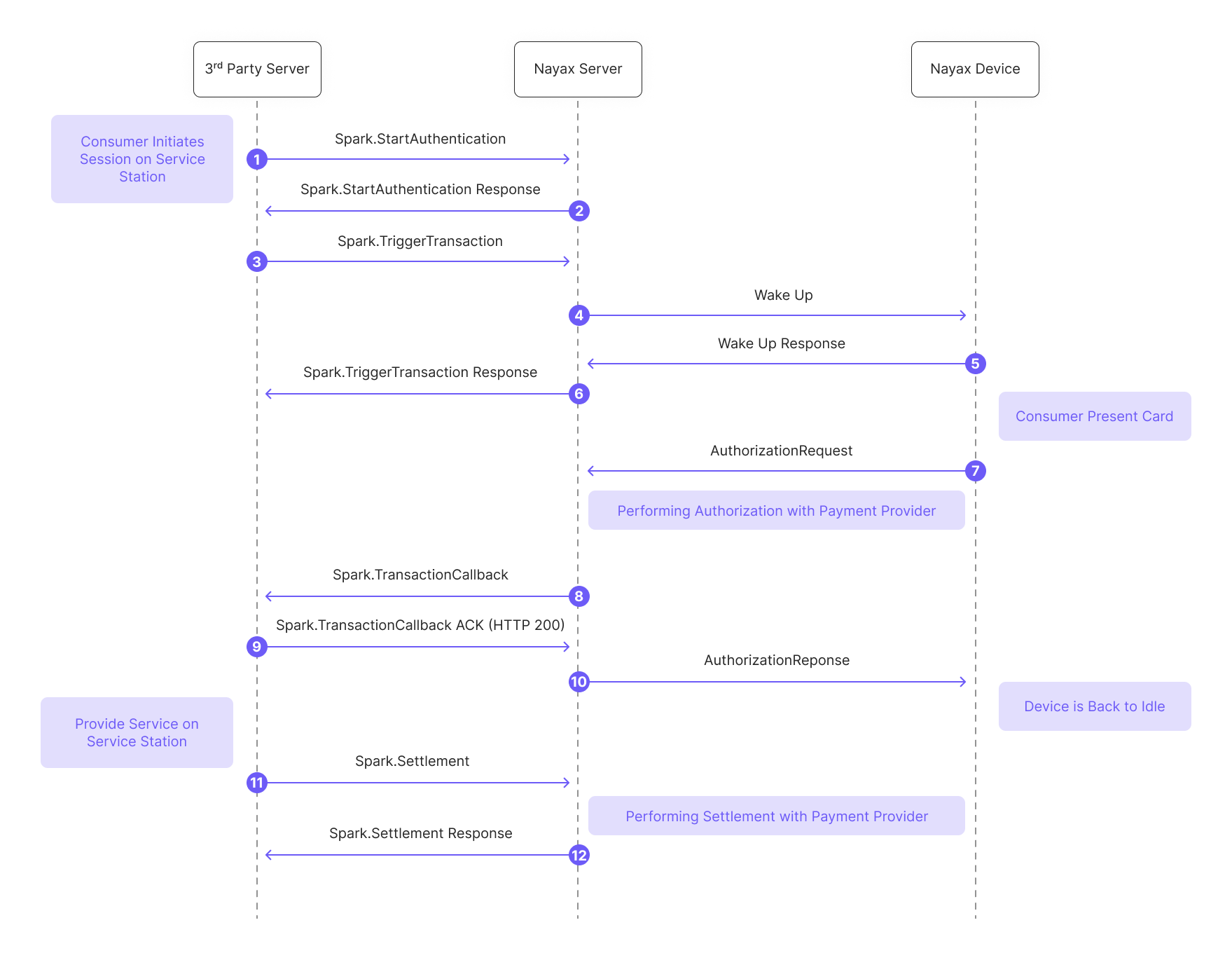 Below is a breakdown of the diagram:
1. A consumer starts a session on a service station, which sends a `StartAuthentication` request to the Nayax Server via a 3rd Party Server.
2. The Nayax Server responds to the 3rd Party Server with a `StartAuthenticationResponse`.
3. The 3rd Party Server sends a `TriggerTransaction` request to the Nayax Server.
4. The Nayax Server sends a "Wake Up" command to the Nayax Device.
5. The Nayax Device responds to the Nayax Server, confirming it has woken up.
6. The Nayax Server sends a `TriggerTransactionResponse` back to the 3rd Party Server.
7. The consumer presents their card to the Nayax Device. The Nayax Device then sends an `AuthorizationRequest` to the Nayax Server.
8. The Nayax Server performs authorization with a Payment Provider and sends a [`TransactionCallback`](/docs/integrate-pos-device/spark/webhook-callbacks/transactioncallback) to the 3rd Party Server.
9. The 3rd Party Server acknowledges the transaction callback by sending a [`TransactionCallbackACK`](/docs/integrate-pos-device/spark/webhook-callbacks/transactioncallback) (HTTP 200) to the Nayax Server. At this point, the service can be provided on the Service Station.
10. The Nayax Server sends an `AuthorizationResponse` to the Nayax Device, indicating the outcome of the authorization. The Nayax Device then returns to an idle state.
11. The 3rd Party Server sends a `Settlement` request to the Nayax Server.
12. The Nayax Server performs the settlement with the Payment Provider and sends a `SettlementResponse` back to the 3rd Party Server.
## Pre-Selection Flow
To understand the remote start pre-selection flow, see the diagram below:
Below is a breakdown of the diagram:
1. A consumer starts a session on a service station, which sends a `StartAuthentication` request to the Nayax Server via a 3rd Party Server.
2. The Nayax Server responds to the 3rd Party Server with a `StartAuthenticationResponse`.
3. The 3rd Party Server sends a `TriggerTransaction` request to the Nayax Server.
4. The Nayax Server sends a "Wake Up" command to the Nayax Device.
5. The Nayax Device responds to the Nayax Server, confirming it has woken up.
6. The Nayax Server sends a `TriggerTransactionResponse` back to the 3rd Party Server.
7. The consumer presents their card to the Nayax Device. The Nayax Device then sends an `AuthorizationRequest` to the Nayax Server.
8. The Nayax Server performs authorization with a Payment Provider and sends a [`TransactionCallback`](/docs/integrate-pos-device/spark/webhook-callbacks/transactioncallback) to the 3rd Party Server.
9. The 3rd Party Server acknowledges the transaction callback by sending a [`TransactionCallbackACK`](/docs/integrate-pos-device/spark/webhook-callbacks/transactioncallback) (HTTP 200) to the Nayax Server. At this point, the service can be provided on the Service Station.
10. The Nayax Server sends an `AuthorizationResponse` to the Nayax Device, indicating the outcome of the authorization. The Nayax Device then returns to an idle state.
11. The 3rd Party Server sends a `Settlement` request to the Nayax Server.
12. The Nayax Server performs the settlement with the Payment Provider and sends a `SettlementResponse` back to the 3rd Party Server.
## Pre-Selection Flow
To understand the remote start pre-selection flow, see the diagram below:
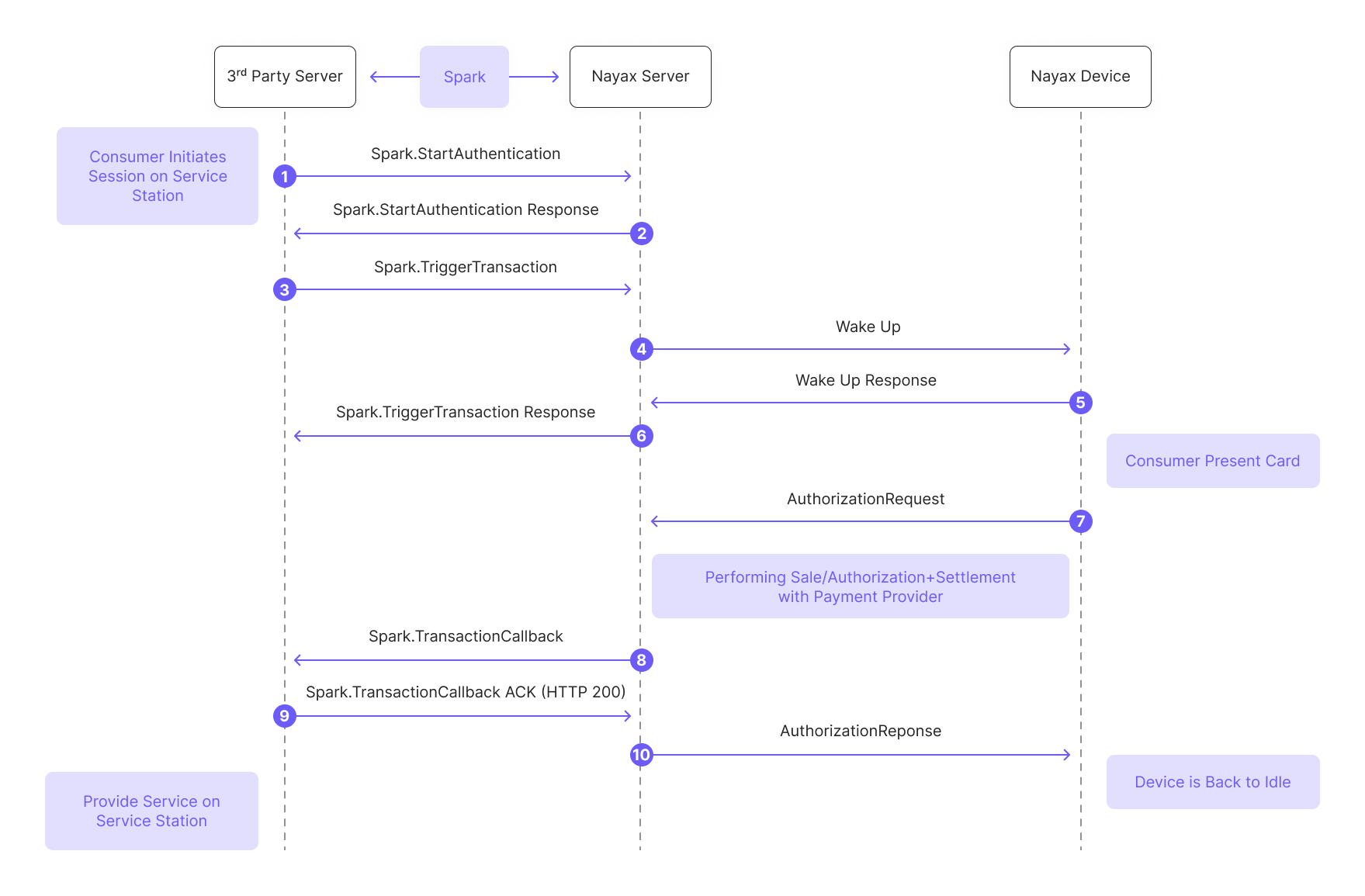 Below is a breakdown of the diagram:
1. A consumer starts a session on a service station, which sends a `StartAuthentication` request to the Nayax Server via a 3rd Party Server.
2. The Nayax Server responds to the 3rd Party Server with a `StartAuthentication` Response.
3. The 3rd Party Server sends a `TriggerTransaction` request to the Nayax Server.
4. The Nayax Server sends a "Wake Up" command to the Nayax Device.
5. The Nayax Device responds to the Nayax Server, confirming it has woken up.
6. The Nayax Server sends a `TriggerTransaction` response back to the 3rd Party Server.
7. The consumer presents their card to the Nayax Device. The Nayax Device then sends an `AuthorizationRequest` to the Nayax Server.
8. The Nayax Server processes transactions by performing sales, authorizations, and settlements with a Payment Provider. Concurrently, it sends a [`TransactionCallback`](/docs/integrate-pos-device/spark/webhook-callbacks/transactioncallback) to the 3rd Party Server.
9. The 3rd Party Server acknowledges the transaction callback by sending a [`TransactionCallback`](/docs/integrate-pos-device/spark/webhook-callbacks/transactioncallback) (HTTP 200) to the Nayax Server. At this point, the service can be provided at the Service Station.
10. The Nayax Server sends an `AuthorizationResponse` to the Nayax Device, indicating the outcome of the authorization. The Nayax Device then returns to an idle state.
## See Also
Notifies you when a card tap completes an authorization attempt.
Below is a breakdown of the diagram:
1. A consumer starts a session on a service station, which sends a `StartAuthentication` request to the Nayax Server via a 3rd Party Server.
2. The Nayax Server responds to the 3rd Party Server with a `StartAuthentication` Response.
3. The 3rd Party Server sends a `TriggerTransaction` request to the Nayax Server.
4. The Nayax Server sends a "Wake Up" command to the Nayax Device.
5. The Nayax Device responds to the Nayax Server, confirming it has woken up.
6. The Nayax Server sends a `TriggerTransaction` response back to the 3rd Party Server.
7. The consumer presents their card to the Nayax Device. The Nayax Device then sends an `AuthorizationRequest` to the Nayax Server.
8. The Nayax Server processes transactions by performing sales, authorizations, and settlements with a Payment Provider. Concurrently, it sends a [`TransactionCallback`](/docs/integrate-pos-device/spark/webhook-callbacks/transactioncallback) to the 3rd Party Server.
9. The 3rd Party Server acknowledges the transaction callback by sending a [`TransactionCallback`](/docs/integrate-pos-device/spark/webhook-callbacks/transactioncallback) (HTTP 200) to the Nayax Server. At this point, the service can be provided at the Service Station.
10. The Nayax Server sends an `AuthorizationResponse` to the Nayax Device, indicating the outcome of the authorization. The Nayax Device then returns to an idle state.
## See Also
Notifies you when a card tap completes an authorization attempt.