CardTokenReceived
This event is triggered after a card token is successfully retrieved.
- JSON
- Android
- Linux
Open loop example:Closed loop example:Parameters:
{"jsonrpc":"2.0", "method": "CardTokenReceived", "params": {"status": "OK",
"errorCode": 0, "errorDescription": "", "CardToken":
"WSAr79nKPywW3INXrWvr6IL3vgTgSJlwZBgseKDmMHM=", "PartialPan": "",
"CardType": "EMV"}, "id": 702}
{"jsonrpc":"2.0", "method": "CardTokenReceived", "params": {"status":
"LocalCLP", "errorCode": 0, "errorDescription": "", "CardToken": "73D0D1C5",
"PartialPan": "", "CardType": "Type A"}, "id": 702}
| Parameter | Description |
|---|---|
status | Transaction result: OK, Declined, Error, Timeout, Cancelled, or LocalCLP. |
errorCode | Numerical error code. 0 when there is no error. |
CardToken | Card token. Base64 string for payment cards, or the card UID for closed loop (Mifare) cards. |
PartialPan | Masked PAN with the card account number’s first six and last four digits. Empty for closed loop cards. |
CardType | Card scheme (for example, EMV, MasterCard, Visa). For closed loop cards, the card technology (for example, Type A, Mifare). |
Java
void CardTokenReceived(TokenDetails tokenDetails);
| Parameter | Description |
|---|---|
tokenDetails | String with the Card token. |
Linux
void LibOtiKiosk_Register_GetTokenResponse_Callback(GetTokenCb_t cb);
cb: A callback function of type void (*)(otiKioskGetTokenResponse* resp). This function is triggered automatically when a card token operation completes.The callback receives a pointer to an otiKioskGetTokenResponse struct with the token result:C
typedef struct {
otiTransactionStatus status; // Operation status
int error_code; // Error code if failed
char error_message[100]; // Error description
char card_token[128]; // Generated card token
char card_type[32]; // Card scheme (e.g., EMV, Visa, Mifare)
} otiKioskGetTokenResponse;
| Field | Description |
|---|---|
status | Status of the token operation. Same values as the JSON status field. |
error_code | Numerical error code. 0 when there is no error. |
error_message | Short technical description of the error, for developer and support use. Do not display to users. |
card_token | Generated card token. Base64 string for payment cards, or the card UID for closed loop cards. |
card_type | Card scheme (for example, EMV, Visa) for payment cards, or card technology (for example, Type A, Mifare) for closed loop cards. |
ReaderMessageEvent
This callback provides updates on user interface messages from the card reader.
- JSON
- Android
- Linux
{"jsonrpc": "2.0", "method": "ReaderMessageEvent", "params": {"index": 36,
"line1": "Authorizing", "line2": "Please wait"}}
| Parameter | Description |
|---|---|
| index | The index of the message – Decimal value according to the Message Index table. Note: The actual text presented on the reader display depends on the Kiosk configuration and may differ from the table values. |
Java
public ReaderMessage(int index, String line1, String line2)
| Parameter | Description |
|---|---|
index | The index of the message. Decimal value according to the Reader messages Index table. |
line1 | Text is shown on the 1st line of the reader display. |
line2 | Text is shown on the 2nd line of the reader display. |
Reader ConfigurationFor this feature to work, the reader must be configured to send External Display message events (Tag DF 46 with index 04).
Linux
void on_reader_event(uint8_t msg_index, char* line1, char* line2) {
printf("Reader Display: %s | %s\n", line1, line2);
}
LibOtiKiosk_Register_ReaderEvent_Callback(on_reader_event);
SystemStatusChanged
This method is only available for the Android operating system.
SystemStatusChanged event indicates changes in the SDKs or connected devices’ operational state.
Java
void onTransactionComplete(TransactionResult result);
SystemStatus is an enumeration representing the current state of the system. See the possible result values in the table below:
| Result | Description |
|---|---|
Ready | The SDK is ready for transactions. |
NotReady | The SDK is not operational. |
PaymentTransaction | A transaction is currently in progress. |
Update | A firmware or configuration update is ongoing. |
TransactionComplete
EMV Core calls TransactionComplete when a transaction completes, whether it succeeds or fails. It gives your application the details needed to print a receipt and link transactions to sale events (for example, in a dispute).
- JSON
- Android
- Linux
Open loop request:Closed loop request with mifare_read:To use 

Response:Parameters:
JSON
{
"jsonrpc": "2.0",
"method": "TransactionComplete",
"params": {
"status": "OK",
"errorCode": 0,
"errorDescription": "",
"transactionId": "2046651064",
"authorizationDetails": {
"AmountAuthorized": 4.50,
"AmountRequested": 4.50,
"AuthorizationCode": "",
"PartialPan": "541333******4111",
"CardType": "MasterCard",
"IsTransactionApproved": true,
"eReceipt": "https://s.wee.ai/tr/...eIHT",
"Card_ID": "",
"Card_Balance": 0.00,
"RRN": "",
"TransactionDbID": "2046651064",
"Transaction_Referance": "2046651064",
"CardToken": "5VXkNqtUDJBxQj9p/qTGt74jWaPHlRs7xxWa1Yu0gDI=",
"Additional_Parameters": {
"hwSerial": "0207122525168550",
"SiteId": "6",
"AllowFundsOverAuthAmount": "false",
"IncrementalMaxDefaultCredit": "450.0",
"EntryMode": "4",
"MachineAuTime": "2026-05-10T16:53:39.017",
"NayaxTransactionId": "6811150712"
}
}
},
"id": 701
}
mifare_read, set the Mifare Blocks to Read attribute in Nayax Core under Embedded Advanced. The following example uses KA01B10B14 to read block 1 with key A, and blocks 10 and 14.
JSON
{
"jsonrpc": "2.0",
"method": "TransactionComplete",
"params": {
"status": "LocalCLP",
"errorCode": 0,
"errorDescription": "",
"transactionId": "4701113B",
"authorizationDetails": {
"CardType": "Mifare",
"Card_ID": "4701113B",
"Card_Balance": 0.00,
"CardToken": "4701113B",
"Additional_Parameters": {}
}
},
"mifare_read": {
"UID": "4701113B",
"B10": "00000000000000000000000000000000",
"B14": "00000000000000000000000000000000"
},
"id": 701
}
JSON
{"jsonrpc":"2.0", "result":true, "id":701}
| Parameter | Description |
|---|---|
| id | Command ID. |
| status | Transaction result: OK, Declined, Error, Timeout, Cancelled, or LocalCLP. |
| errorCode | Numerical error code. 0 when there is no error. |
| errorDescription | Short technical description of the error, for developer and support use. Do not display to users. |
| transactionId | Transaction ID. Use this value in ConfirmTransaction or VoidTransaction. |
| authorizationDetails | Authorization details including amount authorized, amount requested, authorization code, partial PAN, card type, approval status, and card token. |
| Additional_Parameters | Optional data from the PSP in {"fieldName": "fieldValue"} format. Use these values for Nayax External Settlement (Remote Settlement). |
| mifare_read | Block data read from the Mifare card, based on the CLP_MIFARE_READ attribute. Empty when absent. |
Java
void TransactionComplete(AuthorizationDetails authorizationDetails);
In case of no responseIf EMV Core doesn’t get an answer, it will re-send 2 times (for a total of 3 messages), and if it still doesn’t get an answer, it will assume the message received and will not cancel the transaction.
| Parameter | Description |
|---|---|
errorDescription | A short technical description of the error intended to help developers and tech support personnel identify the problem. It should not be presented to users. |
errorCode | A numerical code describing the error if one occurs. See the table below for details on each code. |
status | Possible statuses: OK, Declined, Error, Timeout, Cancelled, LocalCLP. |
amountAuthorized | Amount approved for the transaction in major units (for example, dollars, not cents). May be lower than the original request if the card is prepaid. |
amountRequested | Amount requested for transaction approval in major units (for example, dollars, not cents). |
authorization_Code | PSP Transaction Identifier issued for approved transactions (EVO, Apriva, Traderoot). |
partialPan | Masked PAN with the card account number’s first six and last four digits. |
cardType | Card scheme (MasterCard, Visa, Amex, and others). For closed-loop cards, the card technology type. See the closed loop card types table below. |
authID | Approval Code from the processor (for some processors). |
receiptID | Digital receipt ID in the PSP System. |
Transaction_Referance | Deprecated. Use transactionId instead. |
TransactionDbID | Deprecated. Use transactionId instead. |
RRN | Processor reference number for approved transactions. |
card_ID | Mifare UID in case of a Mifare card and CLP_MIFARE_ENABLED=2. |
isTransactionApproved | Boolean indicating the transaction approval status. |
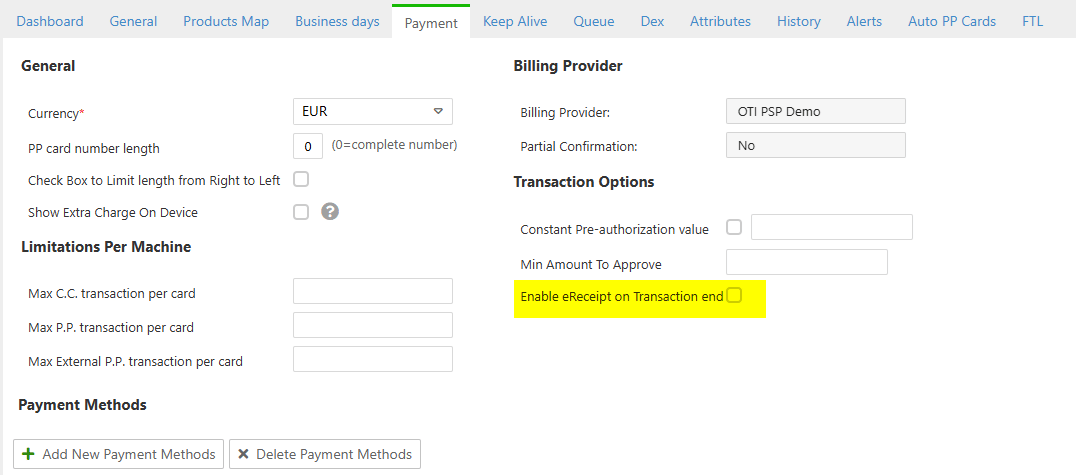
eReceipt | URL for the Nayax eReceipt. See eReceipt settings in Nayax Core for required configuration. |
CardToken | A token identifying the card. For payment cards, it returns a Base64 string. For closed-loop cards (for example, Mifare), it returns the card UID. |
Channel | Channel used for card reading (for example, Contactless, Magstripe, Contact). |
AID, TVR, IAD, TSI, ARC | Card/Transaction parameters that may be used for the receipt. |
transactionTime | Transaction time. |
application_Label | Card scheme (for example, Visa, MasterCard, American Express). |
currency | Currency code according to ISO 4217 (for example, 840 means US dollars). |
CVM | Card Verification Method. |
additional_Parameters | Optional additional parameters from the payment processor. Used for Nayax External Settlement (Remote Settlement). Includes: SiteId, EntryMode, MachineAuTime, NayaxTransactionId, hwSerial, AllowFundsOverAuthAmount, and IncrementalMaxDefaultCredit. |
hwSerial | Hardware serial number of the terminal. |
AllowFundsOverAuthAmount | Whether incremental charges above the authorized amount are permitted ("true" or "false"). |
IncrementalMaxDefaultCredit | Maximum credit amount allowed for incremental authorization. |
card_Balance | Card balance for closed-loop cards managed by Nayax. |
TransactionComplete Closed loop card types
The following card technology types may be returned in the cardType field for closed-loop transactions.| Card Type | Description |
|---|---|
Type A | ISO/IEC 14443 Type A |
Type B | ISO/IEC 14443 Type B |
Mifare | Mifare |
Mifare-U | Mifare Ultralight |
DesFire | Mifare DESFire |
Mifare-P | Mifare Plus |
Vicinity | ISO/IEC 15693 |
Vicinity-P | ISO/IEC 15693 HID iClass |
Felica | FeliCa JIS X 6319-4 |
TransactionComplete Error codes
These are the possible error codes in the response:| Error Type | Error Code |
|---|---|
| JsonParse | -1 |
| General | -1 |
| Terminate | -1 |
| Timeout | -1 |
| Transaction Declined | -1 |
| Positive code | Payment Service Provider (PSP) errors |
Linux
void on_transaction_complete(otiKioskPaymentResponse* resp) {
if (resp->status == otiTransactionStatus_OK) {
printf("Transaction successful: %s\n", resp->transaction_reference);
} else {
printf("Transaction failed: %s\n", resp->error_message);
}
}
LibOtiKiosk_Register_TransactionComplete_Callback(on_transaction_complete);
cb: A callback function of type void (*)(otiKioskPaymentResponse* resp). This function is triggered automatically when a transaction reaches a final state.The callback receives a pointer to an otiKioskPaymentResponse struct with the full transaction result:C
typedef struct {
otiTransactionStatus status; // Transaction status
int error_code; // Error code if failed
char error_message[100]; // Error description
double amount_requested; // Requested amount
double amount_authorized; // Authorized amount
char transaction_reference[128]; // Unique transaction reference
char partial_PAN[20]; // Masked card number
char card_type[32]; // Card type (Visa, MasterCard, etc.)
char card_id[32]; // Card identifier
char card_token[128]; // Secure card token
char EReceipt[256]; // Electronic receipt URL
char Additional_Parameters[256]; // Additional parameters, used for remote settlement
double card_balance; // RFU: card balance for closed-loop cards
bool is_transaction_approved; // Approval status
char authorization_code[128]; // PSP authorization code
char rrn[128]; // Processor reference number
NayaxTransactionIdInfo nayax_info; // Fields for remote settlement
char mifare_read[256]; // Raw JSON of mifare_read params for CLP_MIFARE_READ, empty when absent
} otiKioskPaymentResponse;
| Field | Description |
|---|---|
status | Transaction status. Same values as the JSON status field. |
error_code | Numerical error code. 0 when there is no error. |
error_message | Short technical description of the error, for developer and support use. Do not display to users. |
amount_requested | Amount requested for transaction approval, in major units (for example, dollars, not cents). |
amount_authorized | Amount approved for the transaction, in major units. May be lower than the requested amount for prepaid cards. |
transaction_reference | Transaction ID. Use this value in ConfirmTransaction or VoidTransaction. |
partial_PAN | Masked PAN with the card account number’s first six and last four digits. |
card_type | Card scheme for open-loop cards, or card technology for closed-loop cards. |
card_id | Mifare UID when the card is a Mifare card and CLP_MIFARE_ENABLED=2. |
card_token | Token identifying the card. Base64 string for payment cards, or the card UID for closed-loop cards. |
EReceipt | URL for the Nayax eReceipt. See eReceipt settings in Nayax Core below. |
Additional_Parameters | Optional data from the PSP, used for Nayax External Settlement (Remote Settlement). |
card_balance | RFU. Card balance for closed-loop cards managed by Nayax. |
is_transaction_approved | Whether the transaction was approved. |
authorization_code | PSP transaction identifier issued for approved transactions. |
rrn | Processor reference number for approved transactions. |
nayax_info | Fields required for Nayax External Settlement (Remote Settlement). |
mifare_read | Raw JSON of the blocks read from a Mifare card, based on the CLP_MIFARE_READ attribute. Empty when absent. |
For the full closed-loop card type list and error code list, see the equivalent fields in the Android tab above.
eReceipt settings in Nayax Core
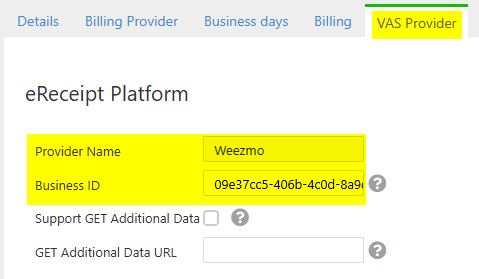
To receive eReceipts, configure the operator in Nayax Core with the following settings.1
Configure VAS Provider settings
In the operator settings, go to the VAS Provider tab. Under eReceipt Platform, enter the Provider Name and Business ID.
2
Update machine payment options
In the machine settings, go to the Payment tab. Under Transaction Options, uncheck Enable eReceipt on Transaction end.