

- Distributor: The topmost entity in the hierarchy, representing a regional or country-level organization that manages multiple operators. Distributors oversee operations but cannot have a parent entity or be created via Lynx API.
- Operator: A business or organization directly under a distributor. Operators manage their sub-hierarchies (areas, routes, machines) and handle inventory, machines, and user permissions. Operators cannot exist under another operator.
- Machine: The physical vending machine containing inventory and sales data. Machines are assigned to specific routes or areas within the operator’s hierarchy and are integral for tracking transactions and alerts.
Hierarchy example
The diagram below illustrates the hierarchy within Nayax, showing how entities are organized from the top level (Distributor) down to the lowest level (Machines).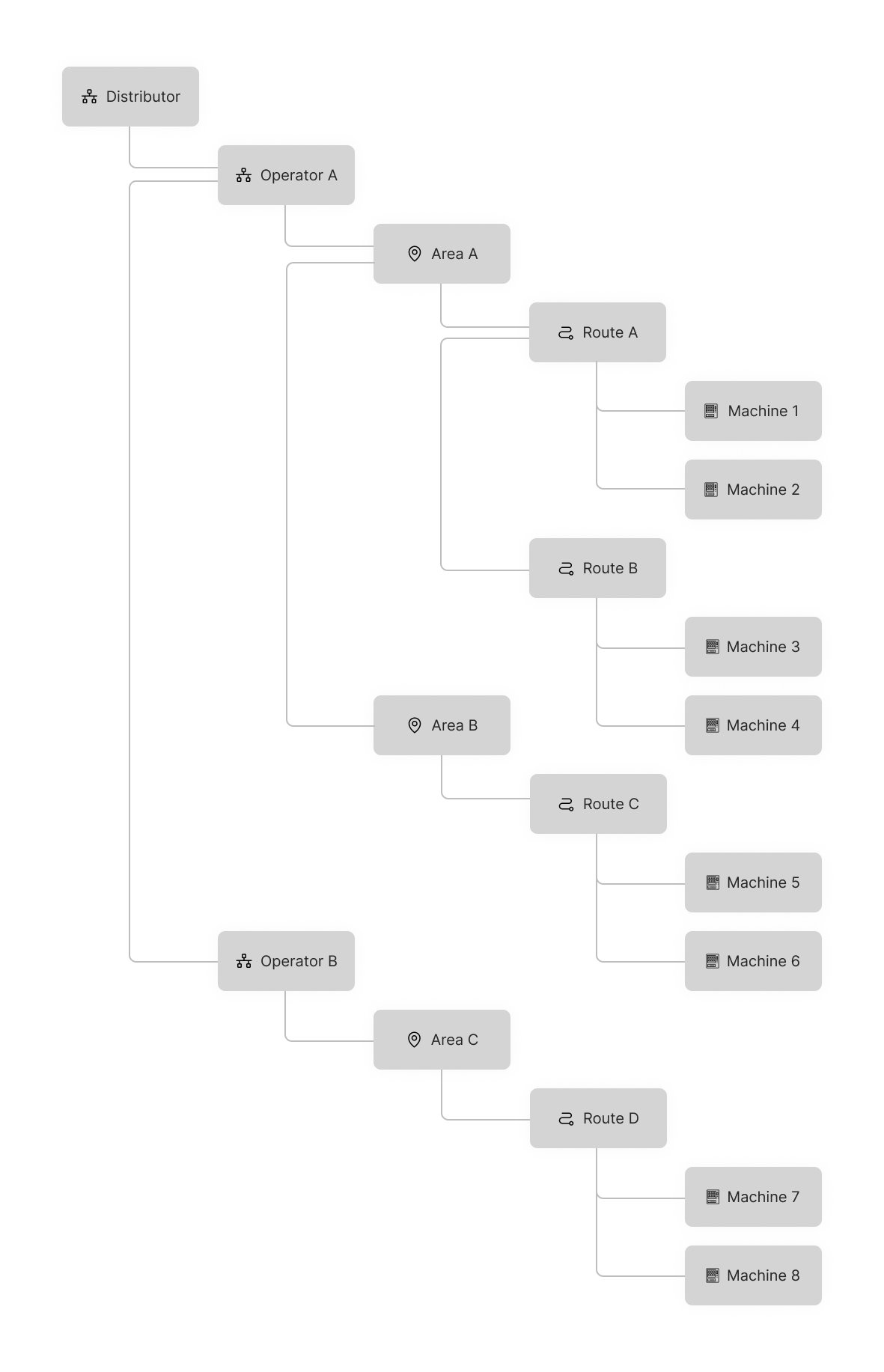
- Distributor: The highest-level entity overseeing the entire structure. In this case, it manages two operators, Operator A and Operator B.
- Operator A manages Areas A and B. Each contains routes that group machines for easier servicing.
- Area A includes Route A with Machines 1 and 2 and Route B with Machines 3 and 4.
- Area B includes Route C, managing Machine 5 and Machine 6.
- Operator B manages Area C, which contains Route D with Machines 7 and 8.
- Operator A manages Areas A and B. Each contains routes that group machines for easier servicing.
Lynx API ActorsIn Nayax Core, the Operators and its types, such as “Area” and “Routes”, are only nomenclatures that help you differentiate them. However, in Lynx API, they are all referred to as Actors, which are only differentiated by the
ActorTypeID.Institutes
Institutes in Nayax are unique entities parallel to operators, created directly under a distributor. They facilitate shared operations between multiple operators for specific locations or use cases, such as implementing unified prepaid card systems across multiple operators’ machines. See the diagram below: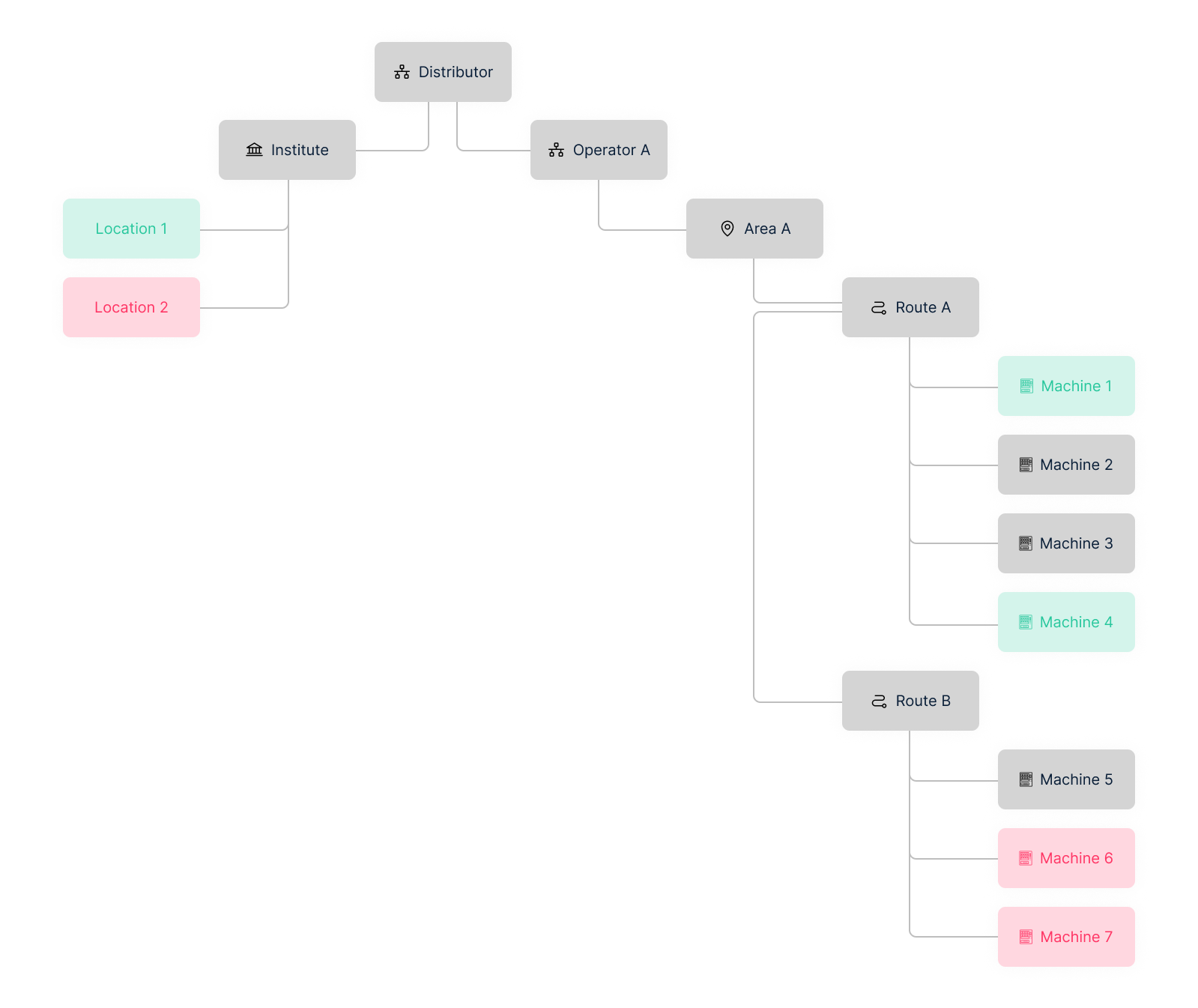
- At the top of the hierarchy, the Distributor oversees both institutes and operators. In this case, the distributor manages Operator A and a single Institute.
- Institutes directly connect to the distributor and are not part of an operator’s hierarchy. They are linked to locations, such as Location 1 (green) and Location 2 (red), which may contain machines serviced by one or more operators.